International Telegraph Alphabet No. 2
A five-unit code that carried most of the world’s printed telegraph traffic for half a century, from teleprinter networks to telex and radioteletype.
In one paragraph
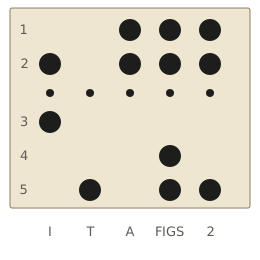
Each character is a group of five on/off elements, so the code has 25 = 32 combinations. That is too few for letters, digits and punctuation together, so two of the combinations are shift signals: after LTRS the receiver prints letters, after FIGS it prints digits and signs from the same patterns. The code descends from Émile Baudot’s telegraph code of the 1870s and Donald Murray’s keyboard version of 1901, and today it is maintained by the International Telecommunication Union as Recommendation S.1.
Quick facts
| Units per character | 5 (plus start and stop elements on a line) |
|---|---|
| Combinations | 32, read in letter case or figure case |
| Printable characters | 26 letters, 10 digits, 11 signs, plus 3 positions left for national use |
| Shift signals | LTRS (combination 29), FIGS (combination 30) |
| Standard | ITU-T Recommendation S.1 (current text 1988) |
| Successor | International Alphabet No. 5, the international form of ASCII |
Where to go next
- The full code table, with the hole pattern of every combination.
- A short history from the printing telegraph to the computer terminal.
- Related topics: start-stop transmission, the baud, telex, radioteletype and paper tape.